
One of the largest deployments ever of GLP’s market leading LED fixtures took place at the Formula 1 Grand Prix in Las Vegas late last year.
Los Angeles-based creative company DX7 Design, who have worked on this event since its inception back in 2023, procured 270 of the JDC2 IP hybrid strobes from vendors PRG, along with 500 of the super-powerful JDC Burst 1 … as their role extended this year way beyond simply outfitting the circuit grid and pit lane, with an outreach right across the city.
Led by the company’s CEO Tom Sutherland, the team created an expansive design, which spread from the track and paddock through six remote fan zones.

Sutherland explained, “Emily Prazer took over as race CEO this year, and her directive was to elevate the event into something more experiential, but within the same budget for lighting, audio and video. Her driving force was to bring Formula 1 more into the entertainment space … and we were given a blank canvas to develop a design that we could lay out across the entire city. It was essentially a festival meeting a sporting event.”
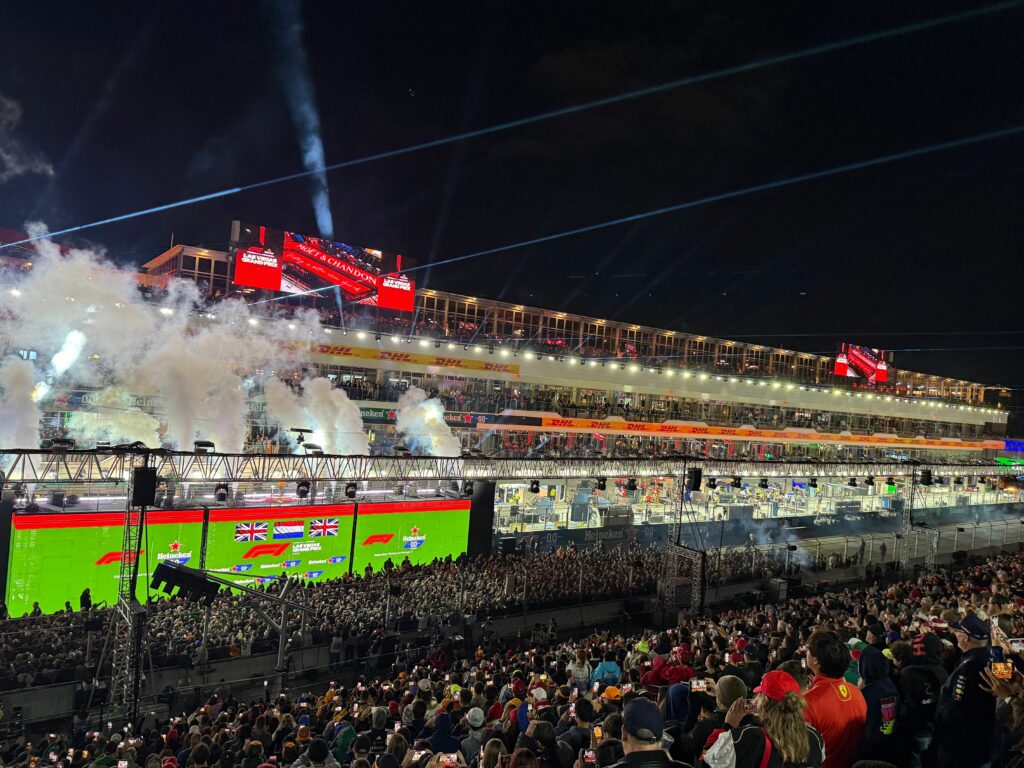
And the dynamic of GLP’s ultra-bright, flexible hybrids was key to the many show elements, including driver introductions, podium celebrations, and of course the fan zones.
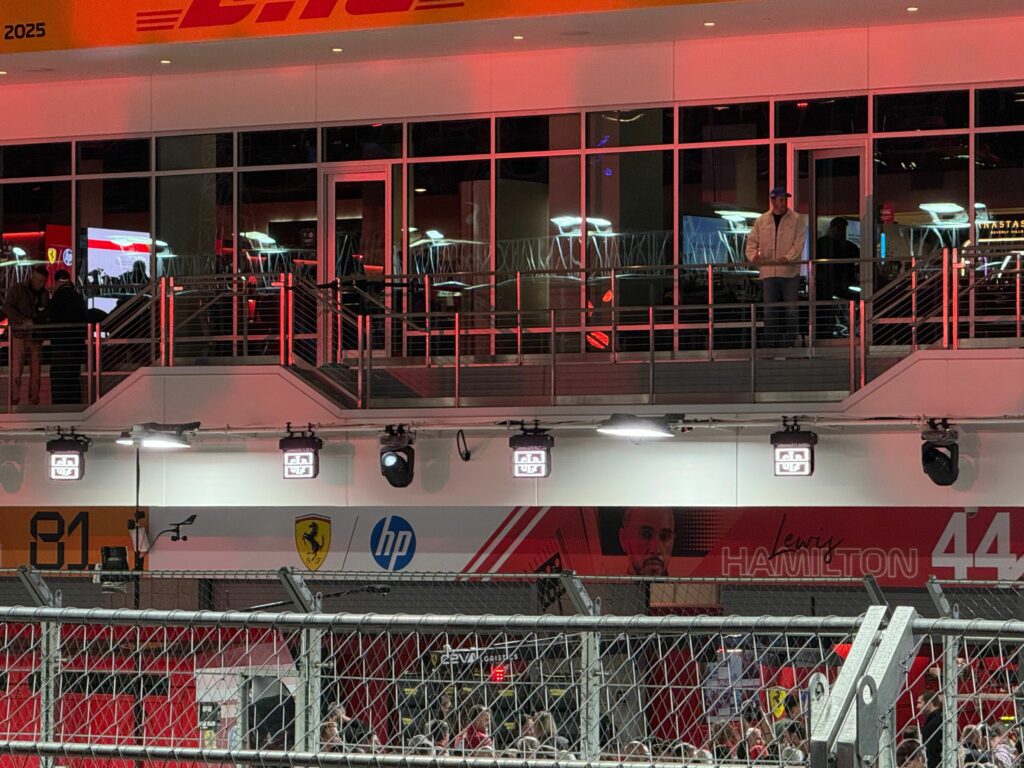
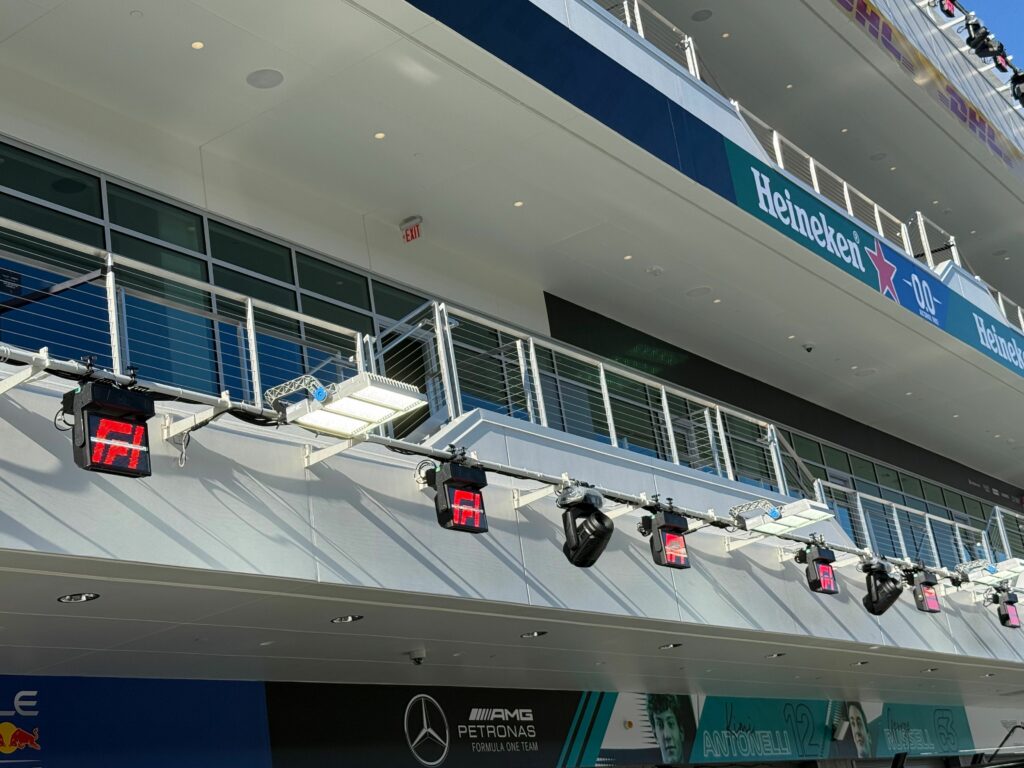
The 270 pieces of JDC2 IP lined the front of the F1 paddock and were used for color chasing, strobe effects and displaying the F1 logo, while delivering the power needed for both live and global broadcast audiences. The ability to display the F1 logo had been one of the event highlights, said Sutherland. Thanks to the fixture’s NDI integration, video content could be streamed to the fixture’s RGB pixel plate, while the DX7 team also made use of the fixture’s library of built-in DigiFX.
DX7 then deployed 500 pieces of JDC Burst 1 across the different fan zones and around the track to create uniquely themed environments for the different sponsors (green for Heineken, magenta for T-Mobile and so on), and there would be different activation moments every 15 minutes. A 12‑segment white strobe line forms the heart of this versatile fixture, either side of which are RGBW LED plates, divided into 48 segments of 5 × 5 pixels each — providing astonishing power output.
Explaining the underlying reasons for his product choice, Tom Sutherland said, “We first used JDC2 on the VMAs [Video Music Awards] last year, and when I showed Formula 1 how we could import their logo, their eyes lit up.” As for the JDC Bursts, they were a perfect antidote for the torrential downpours and hailstorms that dogged the event, and with their extraordinary brightness took center stage against the super-bright backdrop of the Vegas strip.
“We needed to be able to compete with all that lighting on the Strip, so you got a sense of the event in itself,” Sutherland agreed. “But while everything had to be bright, it also had to be IP-rated. Consequently, we had very few drop-outs; all GLP pieces worked flawlessly and maintained their strength throughout, without one failure.” Only the huge cable runs risked exposure to the weather.
Tom Sutherland was supported by DX7 colleagues, James Coldicott (COO), Harry Forster (President) and Hunter Selby (Senior Associate Designer). Programmer was Chris Fernandez, working from three intercommunicating grandMA3 Full-Size consoles stationed in a control center bursting at the seams, running all the GLP pieces in maximum pixel mode for full impact.
Tom Sutherland can reflect fondly on an event believed to have been the largest temporary video, lighting and networking system piloted from one centralized control position to date, not to mention being DX7 Design’s largest ever project. “The sheer scale of the event and weather were the biggest challenges, and it took a lot of very clever nerds to pull that off — to figure out how this system worked and how it went together. There were a lot of beams pointing into the sky — but fortunately, the FAA didn’t give us any grief!
“In fact, the whole event was a huge success, and the Formula 1 organization loved the new look.”
CREW LIST
Designed and Produced by: Tom Sutherland, Harry Forster, and James Coldicott
Associate Designers: Hunter Selby, Erik Alkire, Benedict Conran, Aidan Callanan, Dionte Mercado, Anthony Bishop
Production Managers: Chris Roseli, Chris Lopez, Alen Sisul
Lighting Programmers: Will Chandler, Ryan Tanker, Andrew Law, Grey Nicholson, Chris Fernandez
Screens Producer: Loren Barton
Screens Programmers: Joe Bay, Zak Haywood
PRG Project Manager: Thomas Walls
PRG Rigging Technical Project Manager: Darren Seagren
PRG Lighting Technical Project Manager: Luke Pritchard
PRG Video Technical Project Managers: Joseph Arreola, Eric Geiger
PRG Chief Innovation Officer: Chris Conti
PRG Technical Designer: Benjamin Van Brande
PRG Account Executives: Jeffrey Gainer, Anthony Ciampa
PRG Production Manager: JT McDonald
PRG Production Assistant: Emma Perch
PRG Logistics Manager: Bryan Barry
PRG Lead Rigger: Zac Cromwell
PRG Lead Lighting: Yoshi Shinohara
PRG Lead Video: Mason Braislin
PRG Lead Networking: Ronald Beal
PRG Scenic Project Manager: John Silva, Alicia Sapienza
